
Admissions
Race and College Admissions
 Some time this month, the Supreme Court is expected to rule on a case that could further restrict the use of race as a factor in college admissions.  The issue is whether a student’s race or ethnicity can factor into admissions decisions.
There are many arguments to support why considering race is important, notably the legal rationale of correcting past wrongs. But there are also others who argue that affirmative action does not work or that using economic status will do far more to help.
Ten years ago, the court’s stance is that student diversity is a compelling interest that can justify the use of race, but only as one among many factors.  A recent NY Times  article discusses the updoming decision.
The biggest obstacle to class-based affirmative action, as Richard Perez-Pena pointed out in The Times the other day, is the obvious one: cost. Poor and working-class students are by definition in need of more financial aid. That is why universities have shown little interest in switching. It’s cheaper to bring in students of color from middle-class or affluent families. (It also brings in kids with higher SAT test scores, which count so heavily in the obsessively watched college rankings.) Cost is the reason that even many proponents of class-based affirmative action favor what Tienda calls “a holistic approach†— class and race both.
Head nod to Bill Keller for surfacing this important issue in his article yesterday.
Ask Jeremy: What are the odds of getting in?
 In a recent question all the way from India, Anita asked me about getting into JD/MBA programs.
See below for the question and below that for my video response.
Hi Jeremy,
I am from India. I was born and raised there and I currently work in India. I have a 760 GMAT and am sure that I can manage a good LSAT score as well. Do you think the odds of getting into a JD / MBA program are greater than getting into an MBA program at H/S/ W ? Would you happen to have the stats on what % of applicants to JD/ MBA program at H/S/W are admitted ?
Thanks !
Anita
In short:
1. Consider the other great JD/MBA programs.
2. Don’t get caught up on stats.
3. Focus on your story.
4. CLICK HERE for recent admissions advice.
Good luck!
Ask Jeremy: Response to Ryan about a masters degree in business & technology?
In a recent question, Ryan asked me asked a question on behalf of a friend about getting a master degree at the intersection of business and technology.
See below for the question and below that for my video response.
Source: Twitter
@ryantcameron @jeremycwilson IT friend is looking to get his Masters. Which degree is the best value for a general biz and IT background? #AskJeremy
Structure of my response
Good question. Business and technology will continue to merge.
Three options.
1. Dual Degree
2. MBA+ Classes at other schools
3. Traditional Masters + Business courses
– MSM (MS&E) degree. See Wikipedia page with school options
Think about your career goals when deciding.
Ask Jeremy: “Can you give me some interview advice?”
In a recent question, a reader asked me about interviewing. Specifically, the reader is interviewing for both jobs and possibly for MBA programs.
See below for the question and below that for my video response.
Hi Jeremy,
Congratulations on all of your success! Thank you for the website as well. I am looking to join an MBA program and also doing some interviewing for jobs currently. I wanted to ask about specific challenges to expect during the interview process, and also ask for any tips you might be willing to share. What were some of the key things that you thought helped you enter the program? Thank you.
See below for my video response.
In short, I talk a little about 1) Framing your answer, 2) Content of your answer, 3) tips on interview style and 4) general tips.  Note that the answer here is pretty high level given the general nature of the question.
Tuesday’s Pre-MBA Conference Call
 MLT’s Pre-MBA Conference Call 1.5 days ago was a huge success. More than 100 of you showed up and got to hear from one of the top education nonprofits I know. My apologies to everyone that technical problems kept me from being able to answer questions at the end. But I do have one alternative for you now.
Everyone on the call considering applying to MLT and to MBA programs, I’d love to answer your questions now. I’m starting a new segment here called #AskJeremy where you can Ask Me Anything on Tumblr or on my blog. I’ll answer anything I can help with related to careers, MBA and law school admissions or anything education-related that might come up. I don’t have all the answers but I do have my perspective and the perspective of people I know.
I want to respond via video so I can respond more quickly and concisely.
You can ask by sending in a video question or written question.
I’ll do my best to respond to anyone that writes, but from time to time may give priority to those from my own communities, including those from MLT and anyone interested in sharing your story with education matters should I get more questions than I can respond to quickly.
I look forward to hearing from you all.
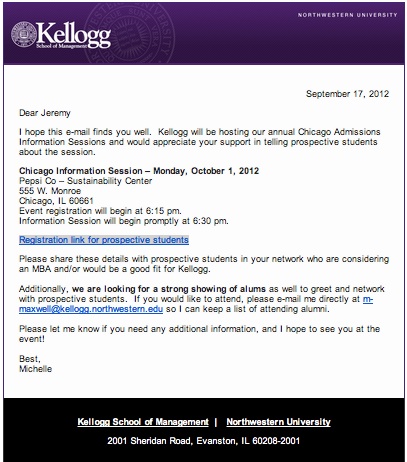
#AskJeremy: Ask me anything at Kellogg MBA Info Session on Monday, October 1, 2012
 For the first time this application season, I’m joining Kellogg at a public MBA admissions event. Given my work hours over the coming months, I’m not sure I’ll make all of them. So I hope you’ll consider coming to this one.
College and graduate admissions season is one of my favorite times of year. Â Applicants are not only visiting campuses, sitting in on the classes and going to info sessions but many are also writing me with questions from all across the world. All in hopes to find a golden ticket into top programs. Well, for people applying to MBA programs, Kellogg School of Management is holding an info session in early October. Â I’m going and would love to meet all of you there.
The event will be held in downtown Chicago at 555 West Monroe, on Monday, October 1, 2012.
In general, these events are a great chance to mingle with potential MBA students and also a great chance to meet admissions officers and learn more about the school.
Meanwhile, I’ll be there and you can ask me anything–the good and the bad–about Kellogg and any top MBA program.
CLICK HERE to register.
And feel free to contact me personally if you’ll be attending.
See you in a two weeks.
#AskJeremy
The look of an MBA student
 What does an MBA student from a top 5 program look like? How do they act and what things have they done? How can I be just like them?
I’ve met MBA students from schools all over the US, who come from every profession. I’ve met early career MBAs fresh out of college and older ones who had big jobs before coming.
And I can tell you this: many of them don’t have much in common. They don’t share gender, job title or income level. They didn’t go to the same college, take the same classes or have the same goals.
Ironically, one thing you’ll notice about MBA applicants is that they all seem to be trying to be the same person. Take the same classes, tell the same stories, talk about the same experiences and submit the same applications. All in hopes to be accepted to their dream schools.
You see the disconnect in all of this, right?
This is bad news is that if you’ve got the wrong genes you are NOT going to make it to the NBA or to the NFL (although I have one friend who figured out how–despite his scrawny stature he still made it all the way). But the good news is that if you want to go to the best business school in the world, become a better leader, and change the way business is done–you can. Â Because neither your genes nor your job will get your in or keep you out.
Actually, MBAs do have one thing in common. Every MBA made the decision to apply to school and then worked hard to make sure they got in.
Most MBA Applicants …
 … apply to business school the same way. They have very similar backgrounds, use the same stories, focus on the same parts of the applications and hope to get into the same schools. Most MBA applicants are smart but here is the problem
Most MBA applicants apply to the same business schools and dont think as much about fit
Most MBA applicants write about making a difference but won’t consider a job in that field post-business school
Most MBA applicants are more eager to get high paying jobs than to do what they are passionate about
Most MBA applicants are persuaded heavily by money when it comes to choosing school and careers
Most MBA applicants don’t focus enough on the essays and overall story when applying
Most MBA applicants talk a lot about leadership roles in their applications instead of leadership experiences
Most MBA applicants aren’t afraid to embellish if it will help get them into school
Most MBA applicants don’t write a clear compelling story about who they are in their application
Most MBA applicants get rejected from more than one school
Fortunately, if you like reading my blog (and not blogs about “odds” of getting in), then you’re probably not like most MBA applicants
Clear Admit Best of Blogging Winner
 After a few weeks of voting, the results for Clear Admit’s annual Best of Blogging competition are finally in! Â According to Clear Admit, the purpose of the BoBs is “to identify and celebrate the applicant and student bloggers who have shared their lives with the online MBA community over the last year.” Without further ado …
I recently got an email informing me that I had won first place in Clear Admit’s Best of Blogging awards as well as in two of the four additional sub-categories.  Thanks to everyone that has visited (even if were only by accident – we have good keywords here).
Going forward, Â we’ll be expanding rapidly. Â Right now, we’re redesigning our website to more organized and far more powerful. And in a few weeks we’ll launch a video Q&A web series, where I can speak with more of you at an even faster rate. Â So as applications and job season begins to heat up and as kids get ready to head off to college this summer, I look forward to speaking with many of you.
Click here to see Clear Admit’s website.
—
Top Student Bloggers
Jeremy:Â http://www.jeremycwilson.com/
Bayo:Â http://nigerianintobschool.blogspot.com/
Julianne:Â http://julianneharty.blogspot.com/
Most Entertaining Student Blog
Bayo
Best Job/Internship Advice
Jeremy
Best Representation of Academics
Jeremy
Best Representation of Student Life
Bayo
Reflecting After 2012 Day at Kellogg Admitted Students Weekend
 Just a few weeks ago, many of you found out you were one of the lucky ones who got a call from Kellogg admissions. They told you that you’d been accepted into the MBA program. Some of you may have been pretty confident you would enroll here in the fall.  But for others you were uncertain, so you wanted to go check out the schools and see what they had to offer. And just a few days ago, when you thought you couldn’t be more excited, many of you come to Evanston to visit Kellogg during DAK (Day at Kellogg), which is Kellogg’s version of Admit Weekend.
First off, congratulations on your acceptance to Kellogg. I remember my acceptance to Kellogg a few years ago . I hope you are thrilled to get in. Second, congratulations to those of you who made it to the admitted student weekend. That was a great decision.
Feedback after the DAK 1 was that everyone had a blast.  And the point of this post is just to quickly to say that I think the same thing was true for DAK 2.  Many of you have already decided that Kellogg was the place for you during your stay, which is great news. And others have been making those decisions all week.
But don’t take it from me, take it from the feedback emails we’ve been getting since DAK ended:
Julia, Jessica, Jeremy, Carrol and Daniel (“these were the section leaders”)
Thank you all very much for an incredible weekend! After recovering from my hangover, I left Evanston incredibly excited about the opportunities and fun I will have over the next two years. You guys did a fantastic job at giving us an understanding of the academic, extra-curricular, career and social aspects of the school. I am incredibly energized and excited, and wanted to let you know you were a huge part of that.
Good luck with the rest of the quarter and in your internships this summer. See you in September!
(Name)
—Second Email
Thanks guys, hats off to you for helping to make DAK such a memorable experience.  I was committed to Kellogg before, but now I’m excited.  See you around campus next year!
(Name)
— Third Email
Jeremy!
You guys were great! Thanks for taking the time out for us and for talking to me more about entrepreneurship at Kellogg. Was great meeting you too!
(Name)
— Fourth Email
I just wanted to thank each of you for a great weekend – Nursery Rhymers had the best leaders!  You were all fun and extremely helpful, answering the many questions we posed while simultaneously entertaining us with your stories and informing us about Kellogg’s resources.  Spending time with such a great group of people set such a positive tone for the whole weekend, and it gave us all a taste of the phenomenal Kellogg culture.  Your enthusiasm for the school was contagious too – I think I can speak for the rest of the section in saying you made us even more excited about being welcomed into such a unique community.
— Email from Sally BlountÂ
Now that you read “some” of the feedback from the participants, why don’t you read the email from Sally Blount that also gives the entire DAK team a bit of good feedback.
— CONCLUSION
#AskJeremy (Applicant Question): MBA Admissions Decisions Involving Money
 We’re bad at figuring out this dilemma. And MBA admissions offices know it. That’s why the scenario comes up every year. And that’s why it comes up at some of the same schools. What scenario you ask? Â This one–You’re accepted to one top business school and you’re thrilled. It’s the place you’ve always dreamed of getting in for the last six months. Â On the other hand, another school gives you nearly a full ride. And tomorrow you have to decide.
First things first. Congratulations! You are in a great position to have both options. And you are lucky to be able to choose from two “top” MBA programs, especially in this economy. One with great professors, smart classmates and great career opportunities. And another with a more famous brand … and a daunting $100K price tag. The million dollar question (or perhaps $100k question) is this.
Which should you take?
In a recent question from one of my readers I got that exact question. But it’s no new question. It’s actually the third time I got the question this week. And fifth time in two weeks.  But before I answer, let me take a second to explain why this is a harder question than you think.
$100,000 is a HUGE number, and in reality it doesn’t mean a whole lot to people just a few years out of undergrad. Â We don’t know what it means to be in debt for a years paying it off. We don’t know where we’ll live or what we’ll be doing after school. And many of us don’t know if we’ll have families in the next few years. So while it’s not a number that we play with, it often isn’t one we truly comprehend.
Secondly, the idea of compromise involving something that is $100K or $150k is hard to understand. Compromising on $5k or $10k maybe. But not over $100K. It just doesn’t make very much sense and can impact our self esteem depending on what choice we make. That’s what makes it hard.
Without further discussion, below is the question and below that is my response.
–APPLICANT QUESTION
**Â Â Note I took out all school names to provide a more fair, honest, and thorough response
Subject: (Top School) brand vs. Full scholarship at (Lower Ranked School)
Message Body:
Hi Jeremy,
I was recently accepted at (Top School) and I’m extremely excited about the possibility of joining the (Top School) family! (Top School) is my top choice but I’ve been offered full scholarships elsewhere (Lower Ranks Schools X, Y, Z). I’ve been offered a 50% tuition scholarship at (School)
I want to make sure that I thoroughly evaluate each opportunity before making a final decision. As an MLT fellow I am surrounded by brilliant fellows who have motivated me to achieve both personally and professionally. I would like a similar MBA experience and from my perspective most top 15 can provide that. I’m interested in pursuing a career in management consulting or health system management post MBA.  My long term goal is to pursue an entrepreneurial ambition.
I would like your opinion on how school selection could potentially impact my career trajectory and professional network. I understand that certain employers emphasize MBA brand over others. I also understand that being obligated to pay high student loans may stifle my ability to pursue entrepreneurial opportunities. Do you think it’s worth the extra money to attend a school like (Top School) vs. (School X or Y)?
Thanks for your time and advice!
(Name)
—-MY RESPONSE
Hey (NAME)
Thanks for reading my blog, and for reaching out with your question about the MBA application process. Â It’s funny how this exact question comes up every single year. In fact, it came up a couple of different times over the past two weeks.
As you might imagine, this question comes up every single year. The combination of schools changes, though not dramatically but the question remains the same. Â Here is what I think.
In short, all comes down to what you value most. And applicants tend to value different things. Some of them value ranking, others prestige, others location, others classmates, others potential job opportunities, and some don’t know what they value. My message as an MBA admissions advisor is usually aimed at the people in that last category, and I try to catch them far before they ever apply to business school so I can help them figure out what they value most. The message is that you have to know what you value early. Because schools will throw money at you, you’ll meet interesting classmates, get exposed to new opportunities, and you won’t have a sense of what you really wanted in the first place.
The problem is that most people don’t know what they value so they start to ask around and get answers. The problem is they ask too many people and the answers are not only diverse but also confusing. In many cases, they look like the following:
- Most alum of (Top School) will tell you that there is a material difference. Especially if they made the same decision. So they’ll tell you to go to their school
- Most alum of School X or Y would say otherwise, especially if they made the same decision. They’ll find reasons you should save the money and go with their school
- Asking someone online (like me) I should theoretically tell you to choose My School which is Kellogg or the school closest in culture to mine
- Many very senior leaders will likely tell you to choose School because they might value the brand of the school. Especially if they recruit at that program.
- Mathematicians would probably do the math compounded over 30 years and prove that the money is not actually a large factor, depending on the industry.
- People who have worked their butts of to succeed will tell you it doesn’t matter, because hard work is what makes the difference, not school name.
- People who have worked really hard but not seen the fruits of their labor will tell you to pick the higher ranked school because that is what will make the difference.
- CEOs will tell you that a degree can really help but they’ve met low performers from all schools.
- Highly successful people from certain disadvantaged communities will tell you pick the best school and dont consider a program that is not highly ranked.
- And people who feel they weren’t given fair chances in their career will tell you to 100% choose the higher ranked School.
- If Steve Jobs were alive, he’d probably tell you that you don’t need an MBA.
- And in terms of Kellogg, one VERY highly esteemed professor always tells people from certain communities that you should 100% take the (Top School) because the network and opportunity is so much better.
- In many cases, I’d probably give similar advice, though that would very depend on the person, on what they told me before my advice.
Like I said, all the answers will confuse you.
In general, my gut is that a good number of people in your shoes choose (Top School) because of what I said in my intro. The stakes feel high, and you don’t want to compromise on such an important decision.  But not every one chooses this. Lots don’t actually. And while some may regret it, others are happy with their choice.
In the end, it’s something only you can decide, based on past experiences, needs, concerns, hopes, thoughts about fit, career aspirations, and value of prestige. Things you should evaluate far before having the decision, so you are prepared to decide once you have to.
But if you haven’t thought about it enough before the decisions, one piece of advice, be careful asking too many people, because you might just get a broad array of responses like the ones above. Stick to the people that know you best and are looking out for your best interest.
For another perspective, check out this interesting thread on BTG about one person’s choice between Kellogg and Ross. http://www.beatthegmat.
Good luck.
2012 MLT MBA Prep Kick-Off Conference
 I’m not surprised that MBA applicants MLT are feeling better than ever. Not only is MLT getting better and better ever year, but the crop of students is also getting better. The students are more driven than ever. The coaches are excited to work with them. And John Rice has as good of advice as ever. And all those things came to pass this weekend at MLT’s Kick off conference in Houston.
At long last, the newest class of MLT’s MBA Prep Program was finally welcomed in person at the 2012 kick-off event. Just like two years ago, the event took place at Rice University, and the good news was that I was able to get a sneak peak at this year’s new class.
I flew out on Friday for the conference and spoke to a number of fellows and alumni this weekend. I spent time with Michael Pages, a friend from my MLT fellowship class of 2009, we spoke with a good number of people at lunch and between sessions. I also worked with a small group of MLT alum on Saturday, to discuss application myths and took part in a Q&A panel.
Even though I’ve been out of the program for a few years, it still feels great to come back and meet the new Fellows. Most were anxious. Some were nervous. And all of them quite excited. And I’m sure they will all do well in the MBA application process this year.
Best of luck to the new Fellows in the program.
And best of luck to MLT with your new set of fellows this year.
Beat The GMAT Scholarship for MBA Applicants
 Hi everyone, hope you are well. Just a quick post to spread the word about a new Beat The GMAT scholarship that launched just a few hours ago today. BeatTheGMAT is the largest social network for MBA applicants in the world, and the team out in Silicon Valley gave me news that now they are offering scholarships for appliants that are applying to business school.
Having spoken with the guys at the company a number of times, I now that giving back and helping others is a large part of the BeatTheGMAT mission. I can also attest that the guys there are really smart. So I think it’s great that they have come out with this scholarship program, and I highly recommend that anyone applying to business school also consider applying to this program.
See below for a blurb about the scholarship from BeatTheGMAT. .
And CLICK HERE to read the press release on the BeatTheGMAT website.
—-
Today Beat The GMAT launched it’s 7th annual Beat The GMAT Scholarship. This is the seventh year of our scholarship program, and this year we are distributing six scholarships worth over $11,000. Each scholarship package includes: a GMAT course, an MBA admissions package, and a GMAT test registration voucher.
Deadline to apply is April 23, 2012. More info available at: http://www.beatthegmat.com/mba/scholarship
—
About Beat The GMATÂ
Founded in 2005, Beat The GMAT is the largest social network in the world for MBA applicants, serving 2 million+ people in the last year. The website features many free resources for GMAT prep, as well as a rich applicant network through MBA Watch.
My Interview with MBA Crystal Ball
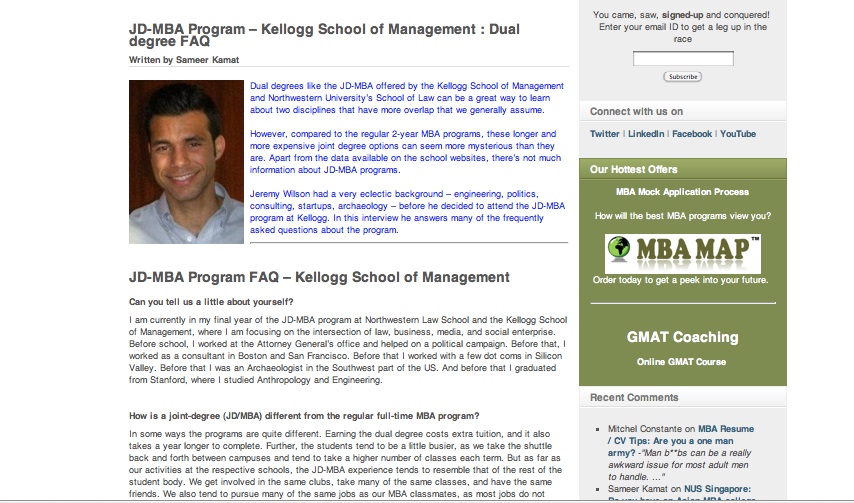
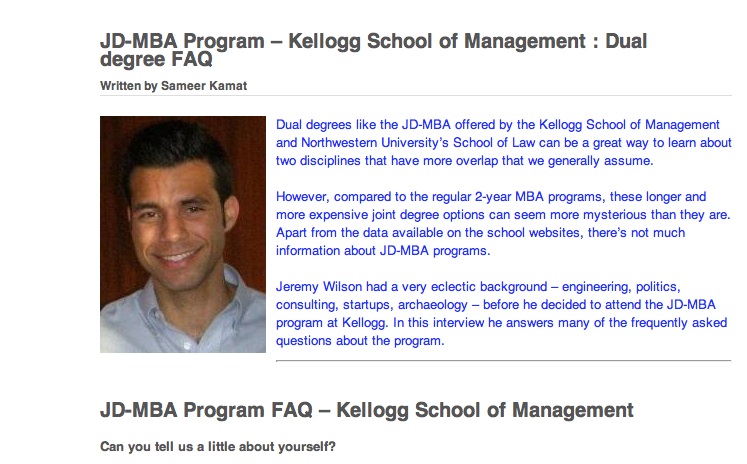 Have you ever considered applying to a JD-MBA program but weren’t quite sure because you didn’t know what it entailed? Have you ever wondered what the differences were between the joint programs and MBA programs? I bet some of you have. I certainly did when I was applying to graduate school. Well if you’re pondering the differences today, or simply want to know a bit more about the joint program, then check out my recent interview with MBA Crystal Ball.
See below for a snapshot of the article and a peak at two of the questions, And CLICK HERE to read the article in its entirety.st last week, I had an interview with MBA Crystal Ball. In the interview I discuss some of the nuances of the joint JD-MBA program. While we couldn’t cover every possible question we did get some of the basic questions: why did you choose the program, how is the program different from MBA programs, do you “need” both degrees, and what I plan to do with the joint program.
http://www.mbacrystalball.com/blog/2012/01/25/jd-mba-program-kellogg-school-of-management/
—
What are the pre-requisites to get into a joint-degree program (and specifically Kellogg)?
There aren’t generally any pre-requisites to get into the joint program. Just like MBA programs look for a diverse class, the JD-MBA program also looks for a diverse set of students from different walks of life to fill the class. Likewise, just like MBA applicants have to take the GMAT, JD-MBA applicants must also take the GMAT. However, one thing that differs at Northwestern is that you don’t have to take the LSAT. While some JD-MBAs do take the LSAT exam, others tend to have very high GMAT scores, which would alleviate any concerns on ability to score well on both exams. And finally, while not a pre-requisite, it is helpful to your application if you have a good reason why you want both degrees. In fact, the JD-MBA program recently added a specific question to ensure students address this.
What are your career plans after completing the program?
In the short run, I’m interested in both business and law, and see myself working at a law firm and in the startup world. In fact, I’m currently working on launching an Internet-based nonprofit in the education sector. So keep an eye out for our Education Matters Project over the next few weeks. Over time, I plan to do more blogging, speaking and writing, which is something that I’m already working on. And in the long run, I’m interested in the public sector. I not only want to work in business, but I also want to give back to my community and help improve the country.
I live by the motto, the greatest risk in life is not taking one. So I hope to take some pretty big risks early in my career after graduating and see what comes of it.

Applicant Question: Should I Take a GMAT Class?
 In some professions, such as banking and consulting, taking a GMAT prep course is a given for prospective M.B.A. students. For those students, the question is never “should I take the GMAT but instead, which one should I use. With so many companies and tutors competing for your attention, it can be difficult to choose which to use. But for others, the decision to take a GMAT class can be tough. Not only because the cost is high but also because you don’t know how much to actually study. Well, in a recent question on BeatTheGMAT I received a question about just that.
In a recent question on BeatTheGMAT I received a question about taking a GMAT class. Because the person had gotten bad feedback on an LSAT class, they were uncertain if they should consider taking a GMAT one.
See below for the question, and below that for an adaptation of my response.
—-
APPLICANT QUESTION
Hi Jeremy,
In preparing for the GMAT, would you recommend prep class or private tutor? I heard one experience from an LSAT prep class that classmates slowed things down since everyone was from different levels/backgrounds. Wondering if it’s similar or different for the GMAT.
(Name)
—-
MY RESPONSE
Hi (Name)
Thanks for your question. I think the answer is different for everyone. Some students have different priorities when applying to MBA programs so may decide to spend more or less time on the GMAT.  And others can sometimes thrive in different environments, where in some cases that environment is a tutor and self study, and other cases it is a formal GMAT class. That said, it is true that far more people take a GMAT class than use a private tutor.  And for those who use a private tutor, many of them have already taken the class and are using a tutor to sharpen up their skills in the weeks leading up to the exam date.
Because in general, the GMAT class should help you get through all the basics you need to do well. The curriculum for “good” classes is up to date, the instructors are top notch (though probably better at some places than others) and the pace of the class is appropriately spaced to get you through everything in the 10 week period (length may vary depending on class). Â Further, the class will help give you a structured schedule with a consistent routine to help learn the information and will give you more resources than you would have on your own.
Of course there are always possible downsides to everything. If you are traveling to a classroom the time investment is more than it would be with a private tutor. Likewise, the cost is greater and you don’t always have a chance to choose your teacher.
Personally, I took a GMAT class and saw a lot of others do the same. I had no problem with pace and ended up with a great instructor and would recommend Manhattan GMAT to a lot of other applicants. While I can’t promise the same experience, and don’t have any knowledge about the makeup of the classes you might consider joining, I suspect many of them would not have problems with classmates and won’t end up going to slow. Especially if you have a strong instructor.
Good luck.
Assorted MBA Application Tips. Hopefully They Help
 Hi All. Because it’s MBA application season, I decided to crate an assorted list of MBA application tips. Depending on where you are in the process and how much research you’ve done already, then some of them may be helpful.
Without further ado, see below for the tips:
- Visit schools. Visiting will not only help you to better understand the culture of the program but also help you choose a school if you’re fortunate enough to have lots of options in the spring.
- Don’t think listing people’s names in your essays is going to get you admitted toa school. And don’t put a laundry list of names, because that just looks bad.
- Make a good impression if you visit. While making a good impression won’t get you in, making a bad impression could have the opposite effect.
- Revise your essays. Then revise again. And again. And again. Most people don’t write well enough not to do revisions.
- In your essays, don’t use run-on sentences.
- Count the number of times you write the word leadership, or any derivation of the word leadership, in your essays, and then likely delete some of them.
- Count the number of times you write the word teamwork in your application in your essays, and then likely delete some of them.
- Consider taking the GMAT again. Try scoring in the 80th percentile in both sections. If you don’t be sure to address it in the rest of the application.
- Seek out people with backgrounds that you admire. And think about doing some of the same things they did in their careers.
- Seek out people who recently went through the process and get advice not only on the general process but also the process for that school.
- Let your recommenders know earlier than later that you plan to apply, that way it’s not a surprise when they have to write the letter. Though realize that most recommenders turn them in at the last minute either way.
- In your application, you should prove that you’re employable after graduation.
- Generally avoid applying in round three, even if you’re a competitive applicant. There are some exceptions but not many.
- Sometimes getting advice from too many people will lead to conflicting advice. In some cases you have to take people’s advice with a grain of salt.
- Don’t have too many essays readers. You’ll lose your own unique voice in the process.
- Consider the STAR technique when writing. Not only will it help you organize but also ensure you talk about the things the MBA admissions committees want to hear about. Especially results.
- Be prepared for your interview. Don’t wing it. Some people will create huge documents, dozens of pages long to prepare for any possible question that might arise.
- On average, apply with higher grades and test scores if you are younger in age. It’s not always the case but often.
- Answer the essay questions. Often times applicants have their own agenda and don’t answer questions fully.
- Refine your self-image: You want your application reviewer and your interviewer to walk away with very clear picture of who you are. So be clear.
- Ask yourself “Why?” after reading an essay or evaluating your response to a question. If the answer to “Why” is unclear, then you need to tighten up your responses.
- Don’t come off as a know-it-all when you visit and during your interview.
- Find friends/support groups to support you in the process. Sometimes it’s  useful to get outside advice. And it’s always useful to have support if things don’t fall go way.
That’s it, for now. I told you they were assorted. Good luck with your application.
Management Leadership for Tomorrow in 2011
 Happy holidays everyone. I hope that you’ve been able to enjoy the holiday season so far and spend lots of time with friends and family. 2011 has been a great year for many of us, and we certainly have a lot to be thankful for.  I’m writing this message to put out a few facts about Management Leadership for Tomorrow, an organization I’m part of that also a good year in 2011. Not only did they continue to build the organization but more importantly they also helped a lot of people apply to graduate school and continue to work toward achieving more success than ever before.
In short, 2011 has been another successful year for MLT.  The organization is excited about accomplishments of fellows and alumni over the past year and looks forward to celebrating MLT’s 10th anniversary with you in 2012! Below are a few highlights from 2011 include:
- About 85% of undergraduate Fellows secured full-time jobs at graduation, compared to under 25% of all college graduates;
- Nearly 95% of MLT MBA Prep Fellows matriculated to top 25 business schools, receiving over $15M in fellowships/scholarships
- 93% of Fellows stated that participation in MLT has been a “life -changing experience;
- MLT expanded its Career Advancement Program, for mid-career professionals, to include 40 rising leaders; and
- MLT formed several new partnerships with leading organizations, including American Express, The Broad Center, Capital One, Genentech, Procter & Gamble and Yum! Brands among others. CLICK HERE for their full list of potential partners.
In addition to that, John Rice also did well in 2011, as he was named one of Forbes Impact 30 Social Entrepreneurs.
In short, MLT is having a big impact and not just on diverse business professionals but also on business as a whole. And as a result of the success, MLT is looking forward to 2012 and continuing enhancing its engagement with fellows, alumni and the broader population next year, which will be MLTs 10th anniversary year.
Stay tuned in 2012 to hear more about what MLT is up to. And as always, don’t hesitate to drop me a line if you have any questions about MLT or any one of its programs. Happy to answer any questions you have.
Happy Holidays!
Kellogg Class of 2014: Congratulations on Your Acceptance!
 To the applicants recently admitted to Kellogg’s Class of 2014, great work. Congratulations on your acceptance! Hopefully you are excited about the opportunity to learn more about Kellogg over the upcoming weeks. As a current student, I can’t say enough about how great the MBA experience is, not only because it’s fun and you meet lots of great classmates, but also because of the professional opportunities that you’ll have available right from day one.
But don’t take it from me, take it from the entire student body at Day At Kellogg (DAK) and get a feel for the experience yourself. My fellow classmates and I will all be around to say hello and tell you anything you want to know more about. Likewise the admissions team and student admissions committee members will be working hard to make sure the weekend and the DAK programing is seamless.
This year, DAK 1 takes place the weekend of February 9-11, and the experience is going to be priceless. And no, not just because I’ll be a DAK section leader; but also because you’ll have the chance to attend a class with professors like Hennesey and Rogers; you’ll be able to meet more current students than ever imaginable, and you’ll also get to spend the evenings in Evanston and in the city with other admitted students. And no matter what you decide to do when you’re here, be sure to stop by and say hello. I’d love to hear what options you’re considering.
Best of luck with the rest of your applications. And best of luck with your final decision.

Stories > Numbers. A Webinar from the Art of Applying
 It’s that time of year again, when MBA application season is in full swing. Applicants are starting to hear back about Round 1 interviews and admissions decisions. And Round 2 applications are just around the corner. So at this point, just about every applicant is looking for a competitive edge. A way not only be competitive for admissions but also to stand out and improve their chances of acceptance. Well fortunately, there are resources out there to help. And one great resource, Kaneisha Grayson, Â is helping people is having a great webniar later this week.
Hey guys! Just a quick note that my friend Kaneisha Grayson and her admissions company The Art of Applying will be hosting a FREE webinar about its upcoming Story Over Numbers series on Tuesday, December 6 at 1pm CT. So if you’re interested in the topic, I recommend trying to attend. But even if you can’t attend, they will be sending out a video recording of the webinar to everyone who registers, so be sure to register even if you can’t attend.
In short, here is the scoop on the seminar, from Kaneisha Grayson herself:
The Story Over Numbers is a six week program designed especially for applicants whose “numbers†don’t quite fit the profile of their target schools. The program includes 4 rounds of editing for 4 schools of your choice, essay starter worksheets to help kickstart and structure your essays, a private members-only message board where you can hang out with other applicants, and weekly Q&A phone calls. Story Over Numbers also includes amazing bonus material such as Kaneisha’s Word Count Weight Loss webinar, a free resume video review and lifetime access to the contents of the program. Sign up soon! There is limited seating for both the webinar and the exclusive Story Over Numbers program. You can register for the webinar and join the Story Over Numbers mailing list here.
While I haven’t actually done the seminar myself, I can say that Kaneisha is smart and also knowledgable about the admissions process. She did well in the process herself and when I met her last year, she had a lot of passion about helping other people be successful as well. So if you have a few minutes, sounds it’ll be well worth your time to see what the seminar is all about.
Best of luck in the admissions process!
Applicant Question: Career Change from Sales and Startup to Private Wealth in Business School
 Happy Thanksgiving Weekend! This time of year, people are back at home spending time with friends and families. Â Many of them are just relaxing. Others are students, taking a break from classes, before finals period. And there’s another group of people, that are using the break to apply to business school. They’re hoping next year that when they’re sitting at the table, they’ll be able to say that they’ll thankful for “getting in”. To make the a possibility for as many students as possible, I’ve been responding to lots of email questions this week. One question came from a reader that had a question about career changes in business school.Â
In a recent email, I was contacted by someone I met during my BeatTheGMAT.com online chat series. She asked me about career changes in business school. Specifically, about how to move into Private Wealth Management (PWM) from her current career track. She noted that she had moved away from the path that she had intended so she thought that PWM seemed like a longer shot.Â
I’l note that I didn’t recruit for the Private Wealth Management industry here at Kellogg.  Likewise, I also didn’t recruit specifically in the finance industry. But I do know a fair number of people that did, and I do still have a few thoughts to share on the topic. See below for her question, and below that for my response.
APPLICANT QUESTION
Dear Jeremy,
Thank you so much for your time and for the suggestion. If its OK, I have one more formidable challenge in addressing my application. I am from an engineering background, with 3 years of experience in sales – financial products, insurance industry. I have a very good record in performance and was in the top 10 of the region consistently. However, due to a stalled career and little growth prospects… i got bored and due to lack of further personal and professional growth..clubbed with a mandatory topological relocation.. I took up the opportunity at a start-up..as a Strategy and sales consultant…and have done pretty well here.
My challenge here is that my interest is in Private Wealth Management, that cropped from my exposure to financial products while with my earlier company. But however, my present industry is Advertising and marketing… so my biggest concern is how do I relate my goals and interest to my present job and validate my interest in PWM?? because the shift in industry and job role isn’t realy easy to connect to my goals. My apologies for the long mail– I just thought U should get a more or less clear idea about my background..to get a good advice from you.
Any insightful suggestions would be much appreciated…
P.S: On a personal note, I’d also like to know what would u have done had u been in my shoes?? 🙂
Thanks you in advance!
(Name)
MY RESPONSE
(Name),
No problem on the email. Happy to help however I can. So if I interpret correctly, you spent some time working in the sales and marketing space and currently work for a startup, but you want to go into PWM. after business school  Is that correct? If that’s the case, then even though you have a bit of work to do, the transition may not be as far fetched as you think.Â
Before, I jump straight into the question, I’ll point out that your diverse background is certainly not a bad thing. In fact, having a diverse background is often times a strong plus. It shows you can succeed in lots of professional environments, that you can work well with all different types of people, and that you have variety of skills and interests that could translate across a number of employers. And one of those employers could very well be in the private wealth industry.Â
Join the conversation

#AskJeremy

#EducationMatters
Share your education story

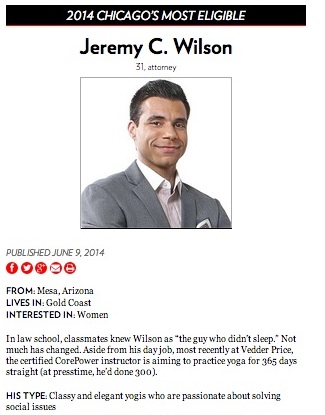
Thank you Chicago for the nomination
Apply to Join MLT

Apply to Join NLC

Learn about the JD-MBA program

Please Vote

Recent Posts
Twitter Feed
Disclaimer
| S | M | T | W | T | F | S |
|---|---|---|---|---|---|---|
| « Jun | ||||||
| 1 | 2 | 3 | ||||
| 4 | 5 | 6 | 7 | 8 | 9 | 10 |
| 11 | 12 | 13 | 14 | 15 | 16 | 17 |
| 18 | 19 | 20 | 21 | 22 | 23 | 24 |
| 25 | 26 | 27 | 28 | 29 | 30 | 31 |